
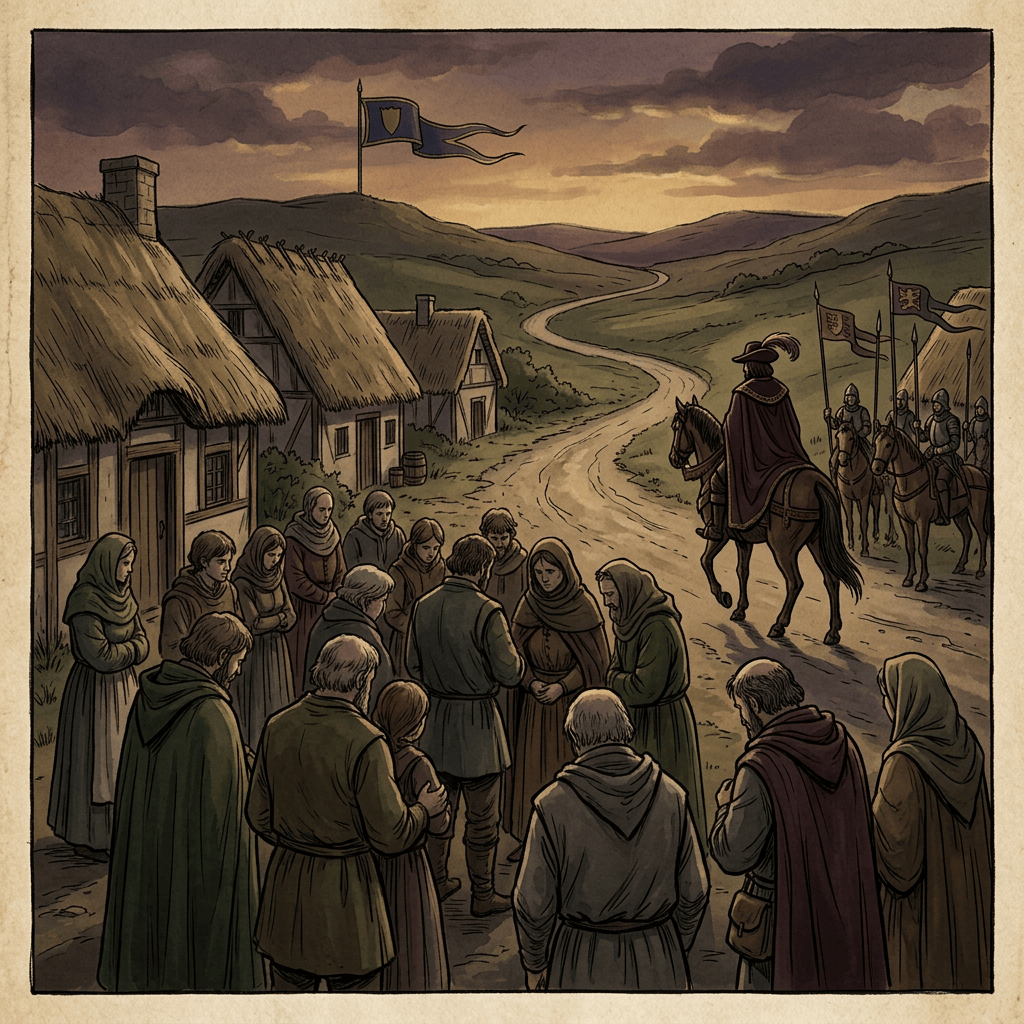
Once there was a wise and generous King whose kingdom was governed by a good law.
But an accuser arose and said: “Your law is impossible to keep. Your subjects obey only because you protect them. If you ever stopped helping them, they would break your law.”
The King replied: “My law is good, and my people can live according to it when they trust me.”
Over many years, people in different villages tried to follow the King’s law. Some succeeded remarkably well; others failed badly. Whenever someone failed, the King forgave them, taught them, and helped them begin again. Then one day the King announced that there would eventually be a final test. Before that test, he would examine the records of everyone in the kingdom. Those who had chosen to trust him would be accepted as his people.
Then came the final village…
The people there knew that the King’s representative would soon leave the village. After that, there would be no further opportunity to change their allegiance. So the people who had chosen the King spent their remaining time learning to live according to his ways. Their old habits were being removed. They became increasingly loyal and trustworthy.
Eventually the King’s representative announced: “The decision has been made. The records are closed.”
He left.
The people of the village now had to face the final crisis without the King’s representative standing beside them.
The accuser appeared and said: “Now we shall see whether they really belong to the King.”
The villagers were frightened. They did not suddenly become independent of the King. They had no confidence in themselves at all. But they remembered his promises and continued to trust him. They refused to betray him, even when doing so would have made their lives much easier.
At last the King himself arrived. The accuser was defeated.
Ellen White wrote extensively about God’s people being prepared for Christ’s return, including overcoming sin and standing through the final time of trouble, particularly in her book The Great Controversy. Later, M. L. Andreasen brought many of these ideas together into what became known as Last Generation Theology (LGT), placing particular emphasis on the final generation demonstrating what God’s grace can accomplish in the lives of His people.
Now notice the two ways the story can be interpreted in the context of Ellen G. White’s famous book and M. L. Andreasen’s well-known theology (amongst conservative Adventists), which emphasised the pre-Advent judgment and the righteousness by faith.
The Ellen White/Great Controversy emphasis could be represented by saying:
The final villagers really were transformed. Their old rebellion had been overcome. They had become loyal and were prepared to stand through the final crisis.
That corresponds quite closely to Great Controversy p. 425: “Their robes must be spotless, their characters must be purified from sin” and they must be “conquerors in the battle with evil.”
But Andreasen adds something more to the story. He says, in effect: The King deliberately allows this final village to become the decisive demonstration that the accuser’s charge was false.
The villagers become the final evidence in the King’s case. Their Victory.
Imagine someone asking, “Did the King need the final villagers to become loyal before he could forgive them?” No, their acceptance had already been settled. “Did the villagers save themselves by becoming loyal?” No, the King had saved and transformed them. “Did the King stop loving or helping them when his representative left?” No, they continued to depend completely upon him. But, “Did their final loyalty provide evidence against the accuser’s claim?” Yes, in Andreasen’s interpretation, that’s a central purpose of the final generation.
The difference isn’t necessarily – Ellen White = grace and Andreasen = works. That’s too simplistic. It is more nearly:
Ellen White: God’s people must be purified, overcome sin, and be ready to stand through the final crisis.
Andreasen: Yes, and their perfected victory constitutes God’s final demonstration before the universe that Satan’s accusation is false and God’s law can be perfectly kept by fallen humanity.
If Ellen White herself explicitly says that the final generation’s perfection is God’s final demonstration to the universe, then Andreasen really is largely systematising what she already taught. If she doesn’t, then we’ve found the point where Andreasen’s LGT develops beyond her explicit statements.
This leaves us with a crucial question: if Paul, Peter, John, Luther, Wesley, and millions of faithful Christians throughout history have been saved through Christ’s righteousness and His ongoing ministry, why would God require the final generation to meet a higher standard in order to be saved?
Is God fair? Perhaps the heart of the gospel is that Christ remains our hope in every generation, including the last.


Leave a comment