
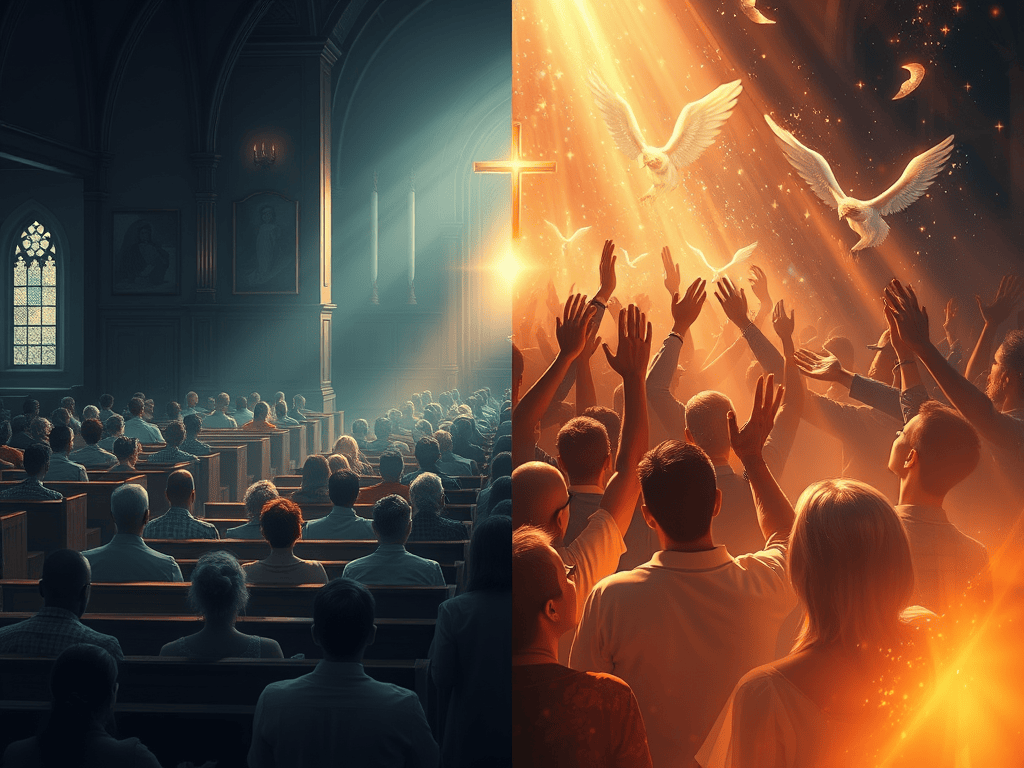
I grew up in a church where worship was a very subdued affair—hymns sung from the pews, hands firmly by our sides, and any movement, even a gentle sway, was considered suspiciously theatrical. Raising hands? That was for the spiritually unruly. We were carefully groomed to believe that emotional displays (except for musically accompanied altar calls) were likely to be the devil’s playground, not a sign of divine connection.
Fast forward a few years, and I found myself in a very different setting—a Pentecostal church. I went in expecting discussions about being a better person, maybe a few tips on parenthood, and some gentle encouragement. What I didn’t expect was an incredible emotional spectacle with spiritual manifestations and prostrations.
After a long, revivalist song service, the speaker began speaking in a language I couldn’t understand—their voice shifted, and suddenly the room felt electric. Gradually people around me started speaking in tongues, some collapsed to the floor, and others lined up for the laying on of hands. When touched, they fell backward. Helpers stood by to assist, to catch them once they lost control and fell. Some had towels to cover any who had fallen and needed assistance with modesty issues or other concerns.
It was surreal, but obviously quite normal for those around me. This was just another routine encounter with the “Holy Spirit”. As was the case with Shouting Methodists 200 years ago, these and other manifestations are considered proof of divine presence.
Historical Echoes: 18th–19th Century Revivals
During the revivals led by John Wesley and George Whitefield in the 18th century, people often collapsed, screamed, wailed, and prophesied under “the power of the Spirit.” Wesley himself documented these events, noting that some collapsed from conviction, others from joy.1
In the Kentucky revivals of the early 1800s, entire crowds swooned, trembled, wailed and cried out. Methodist circuit riders like Peter Cartwright described people falling “as dead” during services. Even Charles Finney, a key figure in the Second Great Awakening, spoke of people fainting under the weight of spiritual conviction.
Wesley and the Supernatural
John Wesley didn’t shy away from the mystical. He believed in visions, dreams, angelic encounters, and even ghostly disturbances—like the famous “Old Jeffrey” poltergeist that haunted his childhood home in Epworth.2 For Wesley, these weren’t fringe beliefs but part of a vibrant spiritual reality that defied Enlightenment skepticism.3
In Methodist and Charismatic theology, manifestations were seen as evidence of the Holy Spirit’s active presence.
- Speaking in tongues is viewed as a spiritual gift (based on 1 Corinthians 12 and Acts 2), either as a prayer language or a prophetic utterance.
- Falling under the power (sometimes called being “slain in the Spirit”) is interpreted as a physical response to divine presence or anointing.
These experiences are often framed as part of the “latter rain” outpouring—a belief that the end times will be marked by a resurgence of spiritual gifts and miracles.
Historical Protestant Interpretations
During the 18th and 19th centuries, revival movements—especially Methodism—grappled with similar phenomena.
- John Wesley documented believers trembling, crying out, and collapsing during his sermons. He saw these as signs of conviction or divine encounter, though he warned against emotionalism without transformation.
- George Whitefield and Charles Finney also witnessed intense physical reactions during revivals. Finney believed these were the result of the Holy Spirit’s power, but emphasized repentance and reform over spectacle.
In these contexts, all kinds of manifestations were welcomed. These included fits, trances, prophecies, visions, hysteria, anguish, losing bodily control, accompanied by shouts of “Glory, glory, glory…”. Prophecies often included accusations against other attendees who didn’t quite meet up to “God’s standards “.
I was surprised to learn that Seventh-Day Adventist heritage is largely based on the experiences of Shouting Methodists. Sister White (Ellen Harmon) and her family were deeply entrenched in Shouting Methodism. Ellen was especially taken by the “enthusiasms” displayed by the most extreme performers on the circuit. She joined other (mostly young females) visionaries who created the confusion and cacophony of a typical Shouting Methodist service. In fact she and her parents were expelled from their Shouting Methodist congregation because they were considered too extreme and too disruptive, while her twin sister, as well as her older brother and sister were never disfellowshipped.
Ellen was one of many young ladies in Shouting Methodism who claimed the gift of prophecy, accompanied by speaking in a shrill voice, shouting, “Glory, glory, glory”, and other shouts, tongues, swooning, and falling to the ground “as one dead”. The more dramatic the “enthusiasms”, the more likely it was to be believed by the congregation as manifestations of the Holy Spirit.
James White became Ellen’s constant companion accompanying her from meeting to meeting where she would demonstrate her manifestations. Most young prophets faded into obscurity, as very few had the resources to become known outside their local congregation, but some, who were carefully managed found their star rising. James was a resourceful man who recognised the power of the printed word and Ellen’s fame spread rapidly. Because of their constant companionship, and travel, good christians started to question their celibacy. They decided to marry. Once married Ellen’s manifestations began to fade and she relied almost exclusively on dispersing her message by the printed word and talks that she gave.
Their paths may never have crossed if it had not been for the work of William Miller and his followers. Ellen was absolutely fascinated by the end of the world and James was an astute follower of Miller’s theories. The Great Disappointment of October 22, 1844 helped to unite them and inspire Ellen’s manifestations which became a uniting force amongst the Adventist movement which grew out of that disappointment.
Although James was deeply intrigued by the manifestations of Ellen, he hailed from a more subdued background—the Christian Connection, a thoughtful and reserved congregation. Other early Adventists who did not share the exuberant Shouting Methodist upbringing also found it challenging to embrace the dramatic visions Ellen displayed. Ultimately, for the growth of the Church, these vivid public manifestations became quieter trance-like confirmations of God’s approval during committee meetings of decisions made by the brethren. Finally, most of her revelations began to emerge in the “night season” after which she would write letters of approval or disapproval.
There has always been ongoing debate about the source and significance of Ellen’s visions. It is helpful to note that she started having these visions as one of many young women prophesying in the Shouting Methodist denomination, but she is one of the few who remained accepted throughout her life.
Cautious and Critical Theologies
Many Reformed and mainline Protestant churches prioritise careful examination of scripture and theological alignment regarding spiritual manifestations. This caution arises from a history of skepticism towards emotional faith displays.
- They may see them as psychological responses to group dynamics or emotional auto-suggestion.
- Some theologians argue that true spiritual fruit is measured not by personal ecstatic experience but by love, humility, and obedience of true disciples (Galatians 5:22–23).
- Although enthusiastic manifestations were common and normalised in the religious life of the Harmon family, none of her family ever followed her into Adventism. In contrast, Ellen’s manifestations were a powerful uniting force amongst the “Little Flock” of remaining Adventists who finally grew to become the Seventh-Day Adventist Church.
Even within Pentecostalism, scholars like Gordon Fee have urged discernment, warning against chasing manifestations.
Modern Reflections
Today, skeptics, along with some theologians, debate these manifestations. Some see them as part of spiritual expression; others argue that they distract from the gospel’s core message.
The key question often becomes:
Do these manifestations glorify Christ —or do they largely serve as a form of spiritual addiction?
Footnotes:
*Methodist songbook, The Hesperian Harp of 1848, has a “dialogue song” between a “Methodist” and a “Formalist,” in which the “Formalist” gives a similar picture of the Methodists.
Such groaning and shouting, it sets me to doubting.
I fear such religion is only a dream.
The preachers were stamping, the people were jumping,
And screaming so loud that I nothing could hear….
The men they were bawling, the women were squalling,
I know not for my part how any could pray….
Amid such a clatter who knows what’s the matter?
Or who can attend unto what is declared?
To see them behaving, like drunkards, all raving,
And lying and rolling prostrate on the ground.
I really felt awful, and sometimes felt fearful
That I’d be the next that would come tumbling down.
In the end, he did come tumbling down. His heart was “glowing,” Christ’s love was “flowing,” and “peace, pardon, and comfort” he found.
Johnson, Frontier Camp Meet, pp. 262-64. https://thunderstruck.org/revivalflames-shout-htm/
*Supernatural Physical Manifestations in the Evangelical and Holiness Revival Movements, Presented at the 32nd Society of Pentecostal Studies/Wesleyan Theological Society. Joint Conference, March 21, 2003 (Paul King Ministries)
*Rutkowski, P. (2009) ‘Witches, Demoniacs and Ghosts: John Wesley’s Methodism in defence of Real Christianity’, in Bystydzieńska, G. and Harris, E. (eds.) From Queen Anne to Queen Victoria. Readings in 18th and 19th century British literature and culture, Vol. 1. Warszawa: Ośrodek Studiów Brytyjskich UW, pp. 387-396. Available from: Academia.edu database.
*Pedlar, J.E. (2016) ‘Review of Methodism and the Miraculous: John Wesley’s Idea of the Supernatural and the Identification of Methodists in the Eighteenth-Century, by Robert Webster’, PNEUMA: The Journal of the Society for Pentecostal Studies, 38(3), pp. 364-365. Available from: Online Journal database.
*Burt, Merlin B. The Ellen G. White Letters and Manuscripts: Volume 1, Appendix B: Ellen G. White and Religious Enthusiasm in Early Adventist Experience.
“During the years immediately preceding the 1844 disappointment, and to a lesser degree in the next few years, Ellen (Harmon) White and other early Adventists were involved with intense charismatic-like experiences. These experiences included outbursts of spiritual rapture in the form of shouted exclamations of praise, prayer, and testimony; physical prostration under the influence of the Holy Spirit; and on at least one occasion, holy laughter. In Ellen White’s experience, shouts of praise and physical prostration were often the precursors of visions or physical healing. Such physical manifestations were familiar occurrences up until about 1860. For Ellen White and many other Adventists, physical demonstration was a part of their spiritual heritage.” (Merlin Burt)
https://m.egwwritings.org/en/book/12667.5893#5893
*Levterov, T.N. (2011) The Development of the Seventh-day Adventist Understanding of Ellen G. White’s Prophetic Gift, 1844-1889. PhD dissertation. Andrews University. Available from: Digital Commons @ Andrews University database (Accessed: 13 June [Year]; link subsequently removed).
*The Shouting Ellen White – Fits, Trances, and Visions*. Experiencing Religion and Explaining Experience from Wesley to James. By Ann Taves. Princeton: Princeton University Press, 1999. Reviewed by A. Gregory Schneider
*The review of Ann Taves’ Fits, Trances, and Visions by A. Gregory Schneider is cited for Andrews University Seminary Studies, vol. 39, no. 1, 2001, pp. 153-155. It is accessed via the Andrews University Journal Archives. The in-text citation is (Schneider, 2001). https://www.andrews.edu/library/car/cardigital/Periodicals/Spectrum/2001_Vol_29/22253256.READER_022.pdf


Leave a comment