
When in Bible Study class, I am sometimes reminded of how easily we can view Scripture through the lens of others, at times, accepting ideas that aren’t actually in Scripture, as if they were scriptural. Not intentionally, but simply because certain voices in history have spoken so confidently that their words become integrated into the beliefs we hold.
Respected Christian thinkers, over time, have added details and embellishments to Scripture in such a way we often overlook their sources.
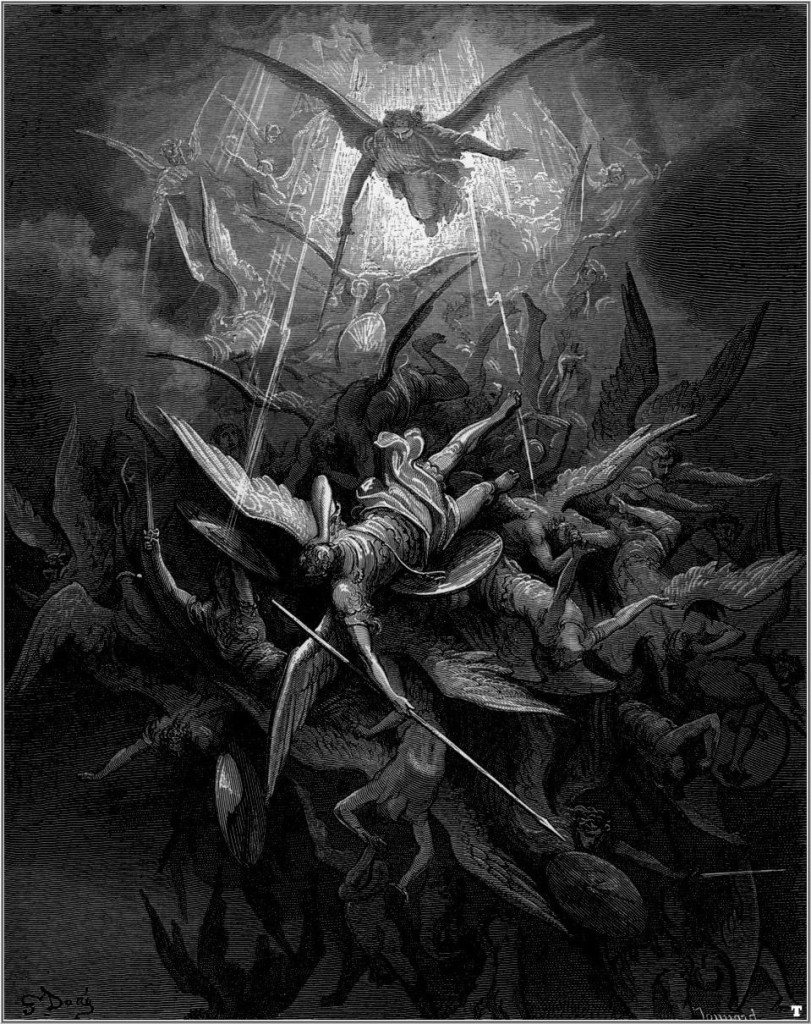
John Milton imagined elaborate scenes of heavenly battles and angelic hierarchies. Milton’s Paradise Lost (1667) completely redefined how we imagine the devil. He invented the concept of Lucifer as a beautiful prideful angel, rebelling because God promoted Jesus above the heavenly host. His imaginative poetry has also given us a backstory for Eve and her problem with apples. Milton’s work appeared in margins of KJV Bibles for centuries.
James Ussher calculated precise dates and chronologies which some creationists treat as Biblically accurate. Relying on the commonly available Masoretic text, and his personal preferences, he gave us a universe created on October 23, 4004 BC, precisely. (well actually the evening of October 22, 4004 BC was when it all began).
John Milton’s poetry taught that the Son (Jesus) was created by God at a specific point in time to serve as the active agent who creates and governs the universe. All evidence points to Milton treating Ussher’s chronology as poetic rather than literal. However, both authors found their way into the vernacular.
With Ussher’s dates in the margins and Milton’s ideas padding sermons in the pulpit, these individual theories hardened into a shared cultural architecture. The public ultimately ingested a worldview built entirely on this makeshift scaffolding, mistaking the poetic framing of Milton and the historical guesswork of Ussher for the solid foundation of the temple itself.
Over time, these additions and embellishments became so widely accepted that people quoted them as though they were part of the biblical text. How easily human additions can become canon.
We can observe this pattern across history, where something interesting happens whenever a community gathers around a strong spiritual voice. Scripture begins as the foundation, but over time, certain writers or visionaries speak with such conviction that their words slowly over time take on a weight that feels… more immediate than the ancient text.
In the eighteenth century, Emanuel Swedenborg produced vast volumes of visionary theology, providing a fresh, direct interpretive lens that carried authority for his followers. This pattern of reading the Bible through a specific filter was hardly unique. A century earlier, the German mystic Jakob Böhme had done the same, a tradition later mirrored in the nineteenth century by both the prophetic Joanna Southcott and Mary Baker Eddy, the founder of Christian Science. For each of these movements, the foundational scripture was viewed through the lens of a singular, charismatic interpreter.
None of these movements began with the intention of elevating a human interpreter; it just happened.
Once a community becomes accustomed to answering questions by asking, “What did she say?” instead of “What does Scripture say?”, the shift is already complete, and it is enough for it to be obvious. The interpreter becomes the anchor, with Scripture taking a back seat. The transition is almost invisible while it’s happening.
You will see this pattern repeated throughout history, although it does not occur in all churches.
The question remains: is the Bible enough for us?
We may deeply enjoy the themes of Miltonic allure in Paradise Lost—a cosmic grandeur that has echoed through the centuries in the gothic horrors of Mary Shelley’s Frankenstein, the visionary poetry of William Blake, and the theological fantasies of C.S. Lewis.
Writers have long borrowed Milton’s majestic imagery to colour their own worlds. Yet, we must remember that Milton’s epic is fundamentally an embroidery upon scriptural truth, not the truth itself. Every claim, no matter how poetically earnest, must be weighed carefully against the unadorned text of the Bible.
Illustration: Gustave Doré (1832–1883), Him the Almighty Power Hurled Headlong Flaming from the Ethereal Sky (Book 1, 44-45) (1866), engraving for ‘Paradise Lost’, John Milton, Cassell, Petter and Galpin, further details not known. Wikimedia Commons.
Further Reading:
https://milton.host.dartmouth.edu/reading_room/contents/text.shtml


Leave a comment