
Satan squatted like a toad and whispered a dream into the ear of Eve.
Milton’s Paradise Lost explains in imaginative prose a fantastical story of the fall of Adam and Eve.
Eve’s Dream in Paradise Lost
In the poem Eve tells Adam of a dream she had: She dreamt that a most beautiful winged creature held forbidden fruit up to her mouth. The fruit smelled so good that she couldn’t stop herself from tasting it.
Then, in her dream, the creature lifted Eve into the sky, and together they flew high above the clouds. From there she could see the whole earth spread out before her — beautiful, and full of variety. She was amazed at how high she had flown and how different everything looked.
Suddenly, the creature disappeared, and she felt herself sinking down. Then she awoke and was relieved to discover it was only a dream.
Eve related the dream to Adam – the glorious winged creature, with an appearance of burnished gold, plucked forbidden fruit, touched it to her face, urging her to eat. Eve was assured that tasting the fruit was no more harmful than touching it, so she ate the fruit that the serpent had given her. She said to Adam,
“Even to my mouth of that same fruit held part
Which he had pluckt; the pleasant savourie smell
So quick’nd appetite, that I, methought, [ 85 ]
Could not but taste.
In her dream, Eve wandered from Adam’s side, drawn away by the alluring serpent, with promises of wisdom and enlightenment. The serpent (Satan) praised her for her beauty, using the words, “nature’s desire”, joy” and “ravishment“. He flattered her that because it’s night, and she’s asleep, nobody can admire her beauty. Her beauty is wasted. In fact, all of nature is waiting to behold her beauty. He promised to make her a goddess, not confined to earth.
Eve was not especially attracted by Satan’s flattery, but was amazed that the serpent could speak. She asked how he had acquired the power of speech. He explained that his amazing powers were obtained through eating the forbidden fruit.
In Milton’s poem, Adam responded sadly, comforting Eve, because he sensed the dream was a forewarning of danger. The angel Raphael had warned Adam that a powerful fallen enemy was lurking in the garden to sabotage them.
However, when Eve gave the fruit to Adam, he ate it because “to lose thee, were to lose myself.”
Because of Milton’s powerful prose, this fantastical scene became part of Protestant lore. Milton’s serpent‑temptation scene, his detailed expansion of Genesis, was never meant to be historical fact.
The Biblical Account: Simple and Unembellished
“Now the serpent was more cunning than any beast of the field which the Lord God had made. And he said to the woman, ‘Has God indeed said, “You shall not eat of every tree of the garden”?’
And the woman said to the serpent, ‘We may eat the fruit of the trees of the garden; but of the fruit of the tree which is in the midst of the garden, God has said, “You shall not eat it, nor shall you touch it, lest you die.”’
Then the serpent said to the woman, ‘You will not surely die.
For God knows that in the day you eat of it your eyes will be opened, and you will be like God, knowing good and evil.’
So when the woman saw that the tree was good for food, that it was pleasant to the eyes, and desirable to make one wise, she took of its fruit and ate. She also gave to her husband with her, and he ate.” (Genesis 3:1-6)
Milton’s imagery emerges as a depiction of a dream experienced by Eve.
What Genesis Does Not Say
- Eve dreamed before the temptation.
- Satan appearing as a toad or whispering dreams.
- Eve wandering away from Adam. (Genesis clearly states that Adam was “with her”)
- Eve wandering off alone, lured by the serpent; (Genesis shows Adam standing with her)
- Angels sent to caution Adam or Eve of the devices of Satan, nor for Eve to never wander from Adam’s side. (They were told only not to eat the fruit)
- Flattery nor appeals to Eve’s beauty (only a direct question)
- Eve asked the serpent how he gained his power of speech.
- The serpent told Eve that his power of speech was gained by eating the forbidden fruit.
- The serpent of Eden had wings.
- The serpent as a brilliant creature of burnished gold.
- The serpent plucked the fruit and forced it onto her face. The Bible says only that Eve took the fruit.
- She was told that eating it was no more harm it touching her.
- That Adam ate the fruit because he could not endure to be parted from Eve.
- Insight into Satan’s psychological strategy.
How Milton’s Version Became Protestant Lore
For nearly three hundred years, Paradise Lost was the second most widely read book in the English‑speaking world, next only to the King James Bible. Sermons, expositions, and commentaries frequently used Milton’s ideas to illustrate and simplify spiritual concepts.
Details in Milton’s poetic invention morphed into accepted facts about the Fall, much as a child accepts a bedtime story. The work of Milton was considered a quasi‑biblical authority.
Church leaders believed Milton’s Paradise Lost was of great value to Christianity. Methodist founder, John Wesley, promoted Milton’s work, insisted pastors study and use it in sermons. He arranged for copies to be sold and placed in libraries. Wesley believed it was of such importance that he produced a simplified version of the poem to enable Christians with a basic education to read and understand.
Milton’s Eden became the Protestant imagination’s Eden. Milton’s prose was converted into Biblical truth in the mind of the masses. By the 19th Century, American Protestant preachers routinely retold the Eden story using Miltons detailed descriptions as if they were historical truth. Most churchgoers were unaware that the extra details were not from the Bible.
The Theological Problem: Entrapment?
But here’s the thing that really stands out for me: If the entire plan of redemption is to prove that God is fair, then a story in which Satan plucks the fruit and forces it against her skin, raises serious theological tension. Is this a form of entrapment – a situation where a person is deliberately induced or persuaded to commit a crime they would not have otherwise committed. Satan’s action in the poem suggests that Eve’s action may be a product of manipulation rather than free will. This reinforces that the action of forcing the fruit onto Eve, was just part of a dream. If this forced touch really happened, would not this suggest that God is not fair to blame Eve?
Milton’s Intent vs. Biblical Truth
Milton’s only intent was to dramatise temptation symbolically using prosaic imagery to capture the imagination. He had no expectation that his Christian Fiction would, over time, be used as historical fact.
To discern the authentic teachings and principles of the Bible we must continually separate Biblical truth from Christian Fiction. Imaginative narratives can help illustrate biblical principles but they should not be confused with Biblical text.
Sermons, commentaries, books and stories have their place, but it’s important to return to the text of the Bible to discover what the Bible actually says.
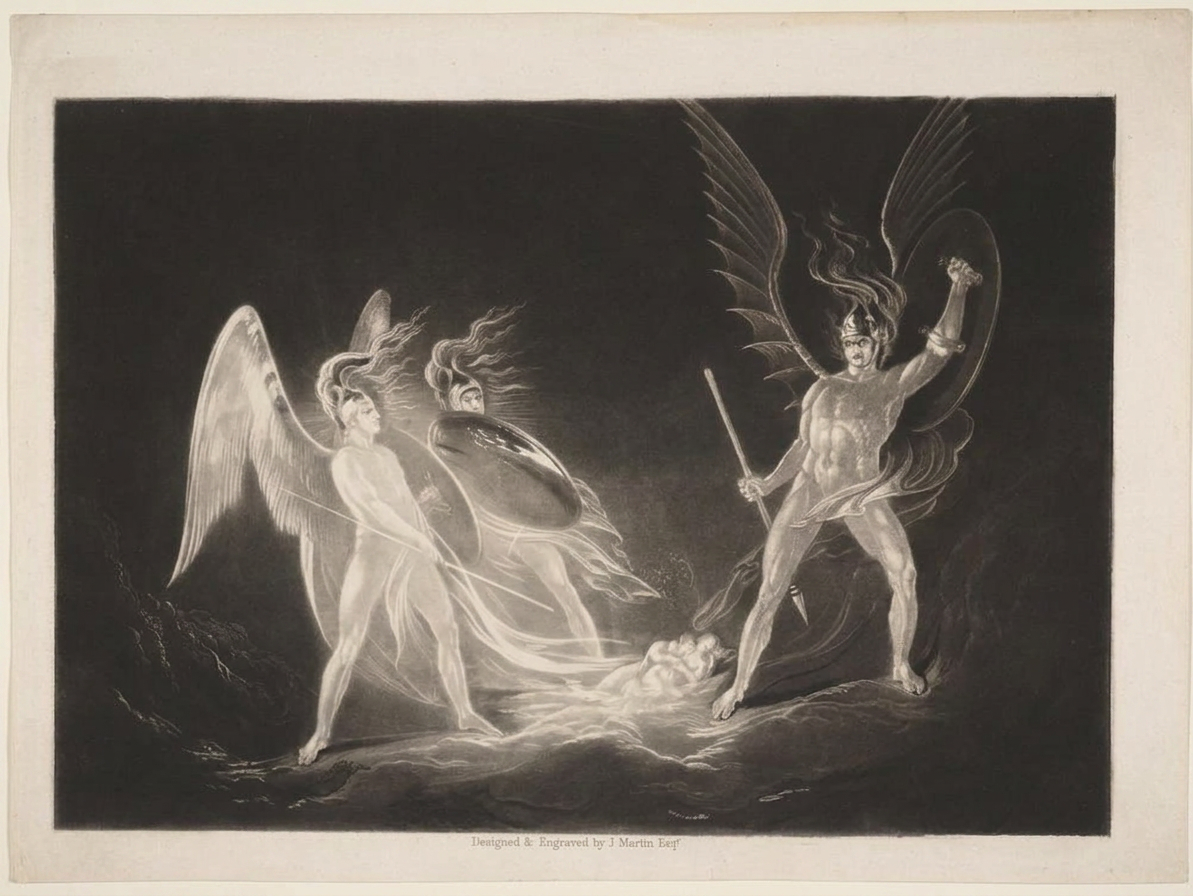
Eve’s dream – Satan aroused (from John Milton’s Paradise Lost) John Martin; artist; 1823-1827; England
Further Reading:
(John Milton, Paradise Lost, Books 4, 5, 7, 9)
Book 5, The Argument
“Morning approacht, Eve relates to Adam her troublesome dream; he likes it not, yet comforts her: They come forth to thir day labours: Thir Morning Hymn at the Door of thir Bower. God to render Man inexcusable sends Raphael to admonish him of his obedience, of his free estate, of his enemy near at hand; who he is, and why his enemy, and whatever else may avail Adam to know. Raphael comes down to Paradise, his appearance describ’d, his coming discern’d by Adam afar off sitting at the door of his Bower; he goes out to meet him, brings him to his lodge, entertains him with the choycest fruits of Paradise got together by Eve; thir discourse at Table: Raphael performs his message, minds Adam of his state and of his enemy; relates at Adamsrequest who that enemy is, and how he came to be so, beginning from his first revolt in Heaven, and the occasion thereof; how he drew his Legions after him to the parts of the North, and there incited them to rebel with him, perswading all but only Abdiel a Seraph, who in Argument diswades and opposes him, then forsakes him.“
Below is an excerpt from further down in book 5 –
“Even to my mouth of that same fruit held part
Which he had pluckt; the pleasant savourie smell
So quick’nd appetite, that I, methought, [ 85 ]
Could not but taste. Forthwith up to the Clouds
With him I flew, and underneath beheld
The Earth outstretcht immense, a prospect wide
And various: wondring at my flight and change
To this high exaltation; suddenly [ 90 ]
My Guide was gon, and I, me thought, sunk down,
And fell asleep; but O how glad I wak’d
To find this but a dream! Thus Eve her Night
Related, and thus Adam answerd sad.”
[John Milton, Book 5]
The John Milton Reading Room. Paradise Lost. Accessed [Date]. https://milton.host.dartmouth.edu/reading_room/pl/book_5/text.shtml.


Leave a comment